
Cutting Waste, Boosting Output: Smart Optimization for Sawmills
Logs are valuable—and every cut matters. Our client wanted to reduce waste, speed up production, and control their future with an in-house lumber optimization tool.

Opportunity
The sawmill leader needed a custom optimizer to minimize waste and reduce dependence on third-party software.
Results
- Proved technical feasibility
- Faster cuts under 2 seconds
- Reduced wood waste
Client
Global Leader in Sawmill Equipment
A global leader in sawmill equipment with operations across multiple markets. Their machinery powers high-volume production lines, and their goal was to pair hardware with innovative software that keeps customers ahead of industry demand.
About the Client
Industry
Heavy Machinery
Headquarters
Indianapolis, IN
Founded
1982
Employees
501-1,000
Opportunity
Owning the Future of Lumber Optimization
For years, sawmills relied on third-party optimization tools to guide their cutting equipment. Our client saw both risk and opportunity: if they could create their own optimizer, they could reduce dependency, gain a competitive edge, and offer customers more efficiency.
The stakes were clear—every second and every board impacts profitability, sustainability, and trust in their brand.
What We Did
Automated Optimization
Computer Vision
Desktop Development
Forecasting/Estimation
Product Discovery
Product Roadmap Coaching
Product Strategy
Prototypes
Release Strategy
Solution
From Discovery to Prototype: Proving Optimization at Speed
We began with a Discovery effort designed to de-risk assumptions and bring stakeholders from across the business into the process. Through rapid prototypes and testing, we quickly uncovered a viable path forward. Using F#, our team built an image-based prototype capable of handling 15–25 boards per minute, simulating the pace of real industry demand.
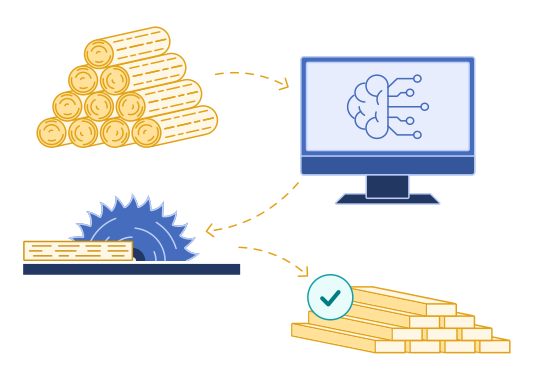
Because board positioning couldn’t be guaranteed, we modeled multiple potential scenarios—each one adding layers of complexity to the optimization problem. Even so, the prototype consistently produced results in under 1.25 seconds, comfortably within the 2-second requirement.
With feasibility proven, we moved into story mapping to outline phased releases and ensure the solution could be delivered in manageable increments. To keep the user experience in focus, we also used low-fidelity “breadboard” prototypes of the interface. This helped us confirm the necessary elements, validate our assumptions, and forecast cost and timeline with confidence.
Tech Stack
 .NET
.NET
 C++
C++
 F#
F#
 Matplotlib
 OpenCV
 Rust
Rust
Results
From Risk to Readiness: Discovery Delivers Confidence
Our collaboration showed that a client-owned optimizer was not only possible but faster and more efficient than their existing tool. The prototype cut processing time to 1.25 seconds while reducing wood waste, giving the client confidence to move forward with full development. With Discovery, prototyping, and roadmap planning, SEP helped set the foundation for an in-house product that secures strategic advantage and sustainability.
Feasibility proven with working prototype
Optimization in under 1.25 seconds
Reduced waste, improved yield
Roadmap for phased product releases
Independence from third-party tools